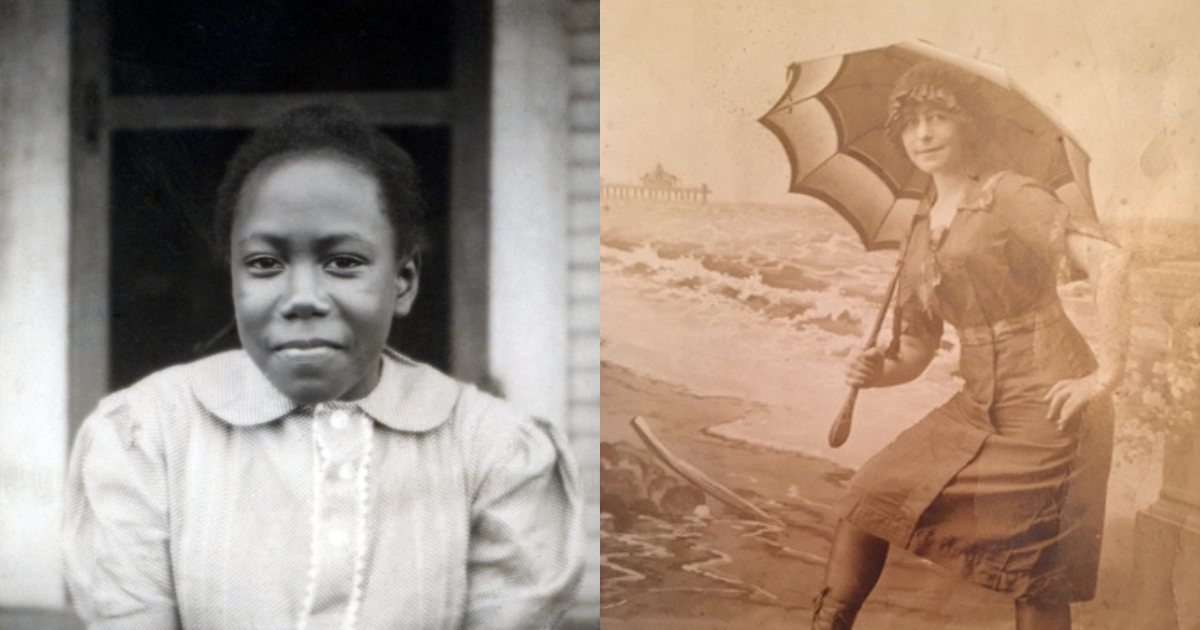
“I wrote a book about Martha Jean (left) and Essie (right), and worked to find the people they came from, because I think that the documentation of that compounded worth is a blessing in itself, a precious inheritance.”-Marcella White Campbell
As anyone who has ever had the responsibility of naming a baby knows, names have a tremendous power. The griots of West Africa, legendary storytellers, open the tales of the deeds of heroes by listing their names and the names of their ancestors. The Torah contains thousands of names that serve as genealogical records. Individually, each one, however obscure, is a single life; collectively, they represent the whole of the Jewish people. Listing them in one place creates an ecosystem of ancestors, a lineage that feels concrete, specific, and very much alive. Knowing their names, even if they are not all paragons or heroes, enhances the weight of the heroic descendants we will later encounter.
In the same vein, when asked to introduce myself, I often begin by talking about my own ancestors. Before you learn that I am a writer, or that I love music, or even that I am Jewish, you will hear that my grandmother and grandfather migrated to San Francisco as part of the Great Migration, part of waves of African-Americans who left the American South, putting Jim Crow at their backs in search of opportunity in the North, Midwest, and West. Before I have begun to tell you about my own deeds, you know something of my people, and you can place me in a context with explorers who built a new life far from home. You know I am speaking with the weight of many voices behind me.
My grandmother, Martha Jean, grew up mourning the absence of those voices. She was orphaned at a young age, and raised by her father’s family, the Ingrams, who did not know, or care to share, much about Martha’s mother, Mary. They came from a family of landowners, with a long and stable Arkansas history, and portraying Mary as a transient without family or past made of her a lightweight, like a dry leaf on the wind. Even in old age, Martha Jean still yearned to know about who her mother had been, to have the certainty of knowing where her mother had been rooted. All she really knew was her mother’s name, Mary Salter; all she had left of Mary was the faint memory of a warm voice, singing. She couldn’t even remember her mother’s face.
Many decades after my grandmother had left us—far too soon—I would be holding an infant daughter of my own, and thinking about names and lineages. Rocking and soothing my baby girl turned my thoughts backwards, to the women who had come before me, a lineage of warm arms craving new lives, a chorus of soft humming in the night. I wanted to know who had comforted Mary Salter when she cried. I wanted my daughter to be entitled to the warm weight of that name.
Luckily for me, my daughter was born just as genealogical databases became reliably available online, and digital archival research is the ideal hobby for a woman who is going to be up all night anyway. Genealogy is, fundamentally, about sifting patiently through databases, looking for the presence of names that will confirm, disprove, or expand scattered memories. I started with the Ingrams, the family Martha Jean did know. They had prided themselves on their rootedness, and I did find their roots. In 1900, Newman Ingram—my 5th great-grandfather—told a census enumerator that his parents had been born in Africa. He was the Ingrams’ progenitor, the first of his line to be born on American soil, the enslaved equivalent of a Mayflower baby. Knowing that lineage had given the Ingrams the pride and confidence to look down on people who didn’t: people like Mary.
Newman’s is the oldest Ingram name I am likely to find, because the paper trail of history ends at what African-American genealogists call the “brick wall of slavery”. In any American census before 1870, enslaved people are only noted as tally notes, not names. I am unlikely to ever know the name of the mother who cradled Newman, let alone the country she was stolen from, because the census did not ask her.
This wasn’t an accident: slaveowners, too, knew that names had power, and the question of whether or not federal censuses should record the names of enslaved people was hotly debated in Congress as far back as 1830. Congressmen from slave-holding states gave the excuse that gathering all those additional names would add too much expense and complexity; one even claimed that it was a waste of time because enslaved women weren’t intelligent enough to know all their children’s names or how many children they had given birth to. But the real issue was an unspoken truth. Abolitionist congressmen knew full well what those names would mean, which was why they were pushing for them to be included. What would the census look like, if the plantations of Arkansas and South Carolina were represented by pages and pages of the names of the enslaved, with their demographic and biographical information side by side with those who had been permitted to own them? What would America look like, before the world, if that window into the reality of slavery—that humans had been tallied alongside bales of cotton, lives reduced to accounting ledgers and balance sheets—were seen? Those names, in aggregate, were too powerful. As it would continue to do until 1861, the South won the debate, and those names were forever lost.
Names, in these old archives, have an incredible power to assert and restore humanity. Thanks to the barbarity of slavery, I don’t know the names of Newman’s mother and father; but, long into many years of searching, when I had been reduced to manually paging through the entire 1920 federal census, I found a name.

On April 4, 1930—two days before Martha Jean’s third birthday—a census taker knocks on the door. A young mother comes to answer and enters recorded history. Mary says that she was born in Mississippi of people born, themselves, in Mississippi, and that she lives in this house with her husband and two little girls. Mary has entered recorded history. That name unlocks a whirlwind of names, hurtling backwards and forwards in time. The 1920 census finds Mary living with her brother Meschach and aunt Martha, and now we know where Martha Jean got her name. Mary’s brother files for Social Security decades later, and that is when he writes down his parents’ names: Dan and Caroline. Caroline is Mary’s mother, and I find their whole family in Mississippi in 1910. I am Marcella, daughter of Yvonne, daughter of Martha, daughter of Mary, daughter of Caroline. All of us, together, hold my daughter.
My daughter is held by many more arms than these. Over the years, I have investigated mysteries in my husband’s family, too, tracing the movements of Ashkenazi Jews through early 20th century migrations from Russia, Lithuania, and Romania to Philadelphia and New York. One name, or a group of names, kept getting my attention: my husband’s great-grandmother, who I had been told was named Ethel, never seemed to have the same name twice in the written record. Was she Atelia, or Atalia? Etty, or Essie? I loved that she had so many names and nicknames, even in official documents. We choose to go by nicknames when they are given to us by those we care about; clearly, Ethel was known by many names because she was loved by many different people. In July 1910, when Ethel disembarked from H.R.S. Campania at Ellis Island in the company of her brother, Schmuel, she offered the name “Essie”.

And that record leads us to another name—Essie’s father, Yosef— and Yosef’s name leads us to a final set of lists. Those are where I find the family Essie had to leave behind, the siblings who did not or were not able to immigrate to the United States. When the Romanian military deported Jewish residents from the town of Dorohoi, they kept careful lists. These chilling records, these lines of terse abbreviations and codes, do not erase the humanity of the lost; they preserve it, serving in permanent and defiant rebuke to evil. My children are the descendants of a chain of daughters and sons whose patriarch, Josef, died in the Shargorod ghetto in 1941. The knowledge of that name, and the indelible record of how he died, accords them the blessing of his memory.
The 13th-century sage Rabbeinu Yonah gives us the wisdom that we cannot advance, spiritually, unless we understand our own worth *and* the worth of our ancestors. Rabbeinu Yonah believed that knowing our lineages—those lists of begats!—would compel us to good behavior by reminding us not to tarnish their great names. I wrote a book about Essie and Martha Jean, and worked to find the people they came from, because I think that the documentation of that compounded worth is a blessing in itself, a precious inheritance. For my children to know they come from Martha and Essie and Yosef and Caroline accords them a lineage that spans continents and oceans, that is documented in the records of ledgers and deportations that seek to obscure evil but only bring it to light, and that lives in the names of the people in whose footsteps they stand and in whose arms they are held.
You can continue to share in the stories of Martha Jean and Essie, and how their names and legacies live on as celebrations of Black and Jewish pride in Marcella’s book, Maya’s Journey: The Story of Two Great Grandmothers.