This year, something happens that doesn’t happen often: my two new years fall on the same day.
On September 11, Ethiopians everywhere, Christian, Muslim, Jewish, and secular alike, will celebrate Enkutatash, the Ethiopian New Year. That same evening, as the sun goes down, Jews around the world will usher in Rosh Hashanah, the head of the Jewish year, with the blast of the shofar and the sweetness of apples dipped in honey. Two calendars, two civilizations, two sets of prayers and songs and foods, landing this year on the exact same day.
For most people, that might read as a curious coincidence. For me, it feels like the closing of a circle I’ve been walking my whole life. I carry both of these new years in my body. I am Ethiopian. I am Jewish.
For the Beta Israel community, which has called Ethiopia home for roughly two thousand years and has always understood its story to begin, long before that, in Israel, the question has often been whether we are Ethiopian enough, or Jewish enough, as if one loyalty could only exist by giving up the other. But most of us never really made that choice, because it was never truly ours to make. We have mostly done the opposite: we have held both, fully, at once, generation after generation. Not a hyphen. Not a divided loyalty. There is no side to choose.

What Enkutatash means, and why it matters that everyone celebrates it
Enkutatash means “gift of jewels” in Amharic. The name comes from a legend that reaches all the way back to the Queen of Sheba, Ethiopia’s Makeda, who is said to have returned home from her visit to King Solomon in Jerusalem around this time of year, welcomed back by her people with jewels to refill her treasury. It is, at its root, a story about a journey between Ethiopia and Jerusalem which is itself the oldest evidence I know of that these two peoples have been in relationship for three thousand years.
Even though that founding legend carries both Jewish and Christian threads, a Hebrew Bible story claimed as heritage by Ethiopia’s Christian tradition, the holiday itself is not owned by either. Everyone celebrates it. That, to me, says something profound about Ethiopia itself. This is a country that was never colonized, that developed its own calendar rather than adopting someone else’s, that reads and writes in its own alphabet, Ge’ez script, rather than borrowing one from abroad. Ethiopia has always insisted on being itself, and part of being itself has meant holding multiple faiths, multiple communities, side by side, and letting a holiday like Enkutatash belong to all of them at once. That kind of religious tolerance isn’t an accident. It’s a civilization that built room for difference into its own foundation.
What I love most about Enkutatash is that it belongs to no single faith. It is a national holiday, marking the end of the rainy season and the start of something new, and it is celebrated by Ethiopian Orthodox Christians, Muslims, Jews, and people of no religion at all, together. Girls sing from house to house. Yellow flowers bloom across the highlands. Families share a meal and wish each other a better year. It’s proof that a new year can be a shared civic joy—not a boundary between communities, but a bridge.

What Rosh Hashanah means, and why the same river runs through it
Rosh Hashanah, Hebrew for “head of the year,” is a very different kind of new year, quieter, more introspective, built around reflection, judgment, and the hope of being written into a good year ahead. But the language underneath it is not so different from the language underneath Enkutatash. Amharic and Hebrew are both Semitic languages, cousins from the same ancient linguistic family. When I say “Enkutatash” and “Shana Tova” in the same breath, I am not switching between two unrelated worlds. I am speaking two dialects of the same very old story.
That story includes my own community’s history: Beta Israel, Ethiopian Jews who trace their identity to Israel while having lived, prayed, married, buried our dead, and built entire lives in Ethiopia for two millennia. Ethiopian Jews are not a footnote to either nation’s history. We are the living evidence that Ethiopia and the Jewish people have never been strangers to one another.

The memories that live in white cloth
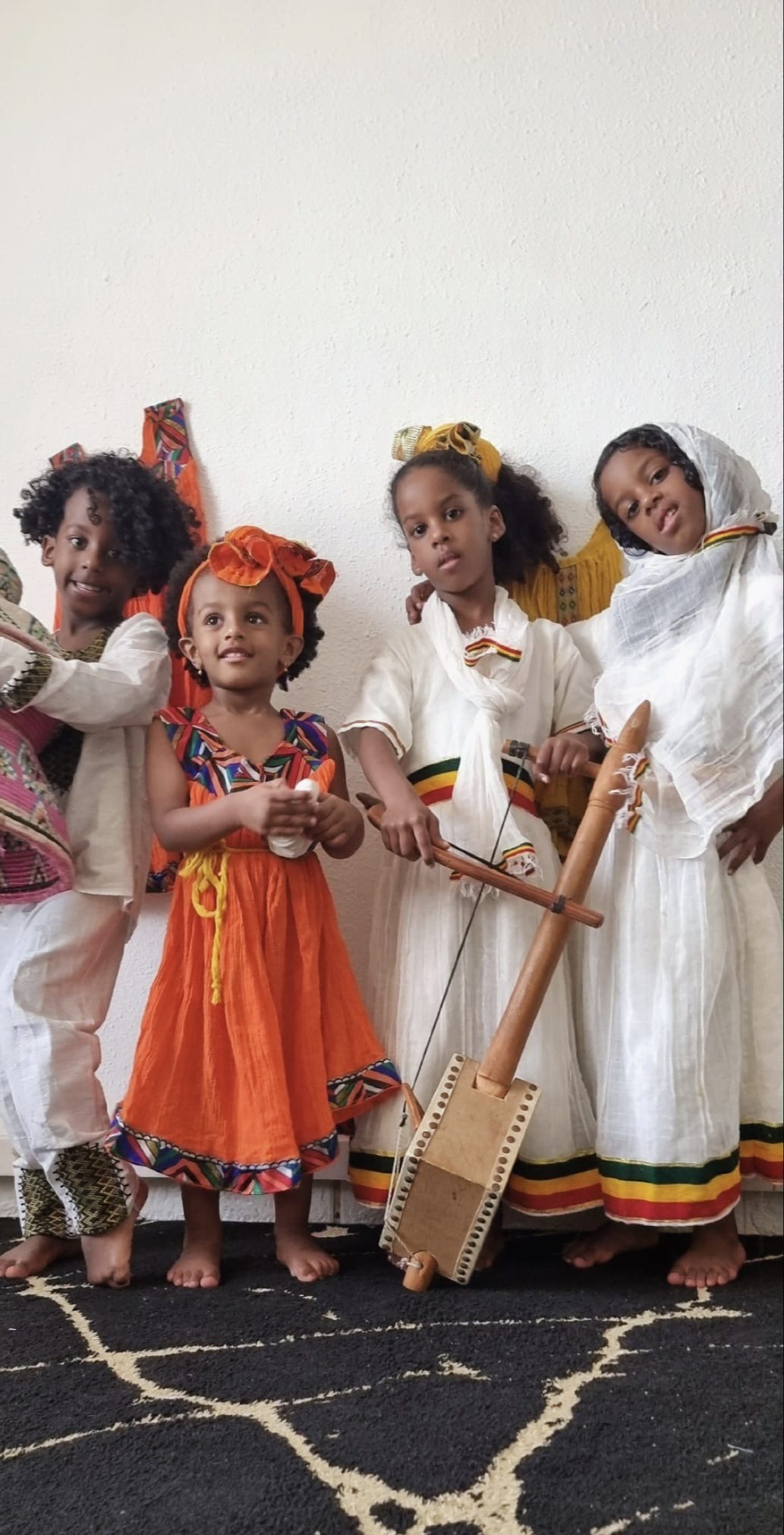
When I close my eyes and think of either holiday, the first thing I see is white. For Enkutatash, it was the habesha kemis, crisp and bright, pulled out and pressed the night before, the colorful woven border catching the morning light. For Rosh Hashanah, it was a different kind of white–simpler, plainer, but carrying the same quiet instruction: begin again clean.
Enkutatash, in my memory, is sound before it is anything else. It’s the voices of girls going house to house, singing the songs that ask for a good year for the family inside, their voices rising and falling in a way that still catches in my chest when I hear it now. It’s the smell of doro wat simmering since dawn, the sight of yellow adey abeba flowers gathered into bunches, the small joy of handing a coin or a piece of bread to a child at the door and watching her face light up. It is, above everything, a holiday of wishing—wishing loudly, musically, door to door, that everyone around you gets a year full of good things.
Rosh Hashanah lives in me differently. It is quieter, turned inward. It’s the sound of the shofar cutting through a room that has gone still, the taste of apples dipped in honey, the specific kind of silence that falls over a table when everyone is thinking about the year behind them and who they need to make peace with before the year ahead begins. It taught me that a new year isn’t only something to celebrate—it’s something to earn, through honesty about where you fell short and the humility to ask forgiveness. Where Enkutatash sends good wishes outward, Rosh Hashanah asks you to look inward first.
Held together, on the same day, those two memories don’t compete. They complete each other. One taught me to sing good wishes into the world. The other taught me to look at myself honestly before I did.

Why I don’t experience this as a split, but as an inheritance
I know that for many people, having two heritages is framed as a tension to manage, a hyphen, a divided loyalty, a “which one is it, really.” I have come to reject that framing entirely. This year, when the calendars align and I get to celebrate two new years on one single day, I don’t feel torn in half. I feel doubled. I get two chances, on the same day, to sit with family, to eat foods that carry centuries of memory, to say out loud that I hope this year is sweeter, gentler, more just than the last.
I think there’s something the wider world could learn from this alignment, especially right now, when so much public conversation insists that identities must compete with each other—that you are either this or that, that solidarity with one people requires distance from another. Ethiopia and the Jewish people have spent thousands of years demonstrating the opposite: that ancient ties, shared calendars, shared linguistic roots, and centuries of intertwined life are not a contradiction to be resolved. They are simply what a long, real relationship looks like.
We have so much more in common than we have to divide us. This year, on September 11, I plan to prove it–with a table set for two new years, and one very full heart.
Shana Tova and melkam Addis Amet!